Center for Advancing Correctional Excellence logo
  Announcements  
Request for Proposals: Systematic Review of the Effectiveness of Sentencing and Corrections

This request for proposals is being extended to those interested in the fields of sentencing, corrections, interventions, and systematic review. We invite you to register your interest in conducting a systematic review that examines key moderators on individual level outcomes. The Bureau of Justice Assistance of the Office of Justice Programs and the Center for Advancing Correctional Excellence! (ACE!) at George Mason University will fund these reviews. The reviews will be conducted under the auspices of the Campbell Collaboration Crime and Justice Group and will follow Campbell Collaboration systematic review procedures (see www.campbellcollaboration.org), and administered by the ACE!. Up to $15,000 will be made available for each review in the following areas:

  • Recidivism as a function of age, ethnicity, gender, offense type and/or criminogenic needs.
  • Use of risk assessment instruments and their relationship to recidivism for general offender populations, for criminogenic, and for non-criminogenic factors.
  • Individual level change as a function of changes on criminogenic needs and reducing recidivism.
  • Impact of programming options on changes in criminogenic needs.

We encourage those that have completed reviews to modify existing reviews to examine potential moderators on various outcomes.


Please review the announcement for submission requirements: Announcement


All submissions are due by October 31, 2011 to Dr. Michael Caudy (mcaudy@gmu.edu).


Addiction Health Services Research Conference

On October 3-5, 2011, ACE! will host the annual conference for Addiction Health Services Research (AHSR). This conference serves as a gathering of scholars and policymakers who work across disciplines to address issues related to addiction. The conference will take place at the Mason Inn and Conference Center.

To register, please visit http://guest.cvent.com/d/ldqywb or email us at ebct@gmu.edu.


The conference program is now available here: Program

Materials from the conference are now available here: Conference Materials

 
What Works in Residential Reentry Centers Study
 
Residential Re-entry Centers (RRCs) are designed to facilitate the transition from prison to the community, and many often serve as halfway back facilities for offenders who have difficulties when placed on community supervision. During this transitional period, the RRCs assist offenders in securing housing and employment as well as continuing in appropriate treatment and other programs to address criminogenic needs. The potential value of these centers cannot be overstated given the length of incarceration and the difficulties of reestablishing housing, employment, and stable relationships. Overall, RRCs are relatively rare in the US with less than one percent of the releasee population having access to some type of re-entry facility (Taxman, Perdoni & Harrison, 2007). This study focuses on residential re-entry contracted by the Federal Bureau of Prisons.


There are 250 RRC contractors who are responsible for nearly 24,000 Federal offenders each year. In this study, the experiences of 9 RRC sites and nearly 40,000 individual case histories were examined with the goal of providing details concerning the following:
• Does performance contracting stimulate contractors to develop evidence-based practices, provide better treatment services or become more efficient?
• What types of offenders are released into communities—to the streets, to residential centers, through home confinement or a mix of all of these?
• What happens to individuals who are transitioned through halfway houses or residential reentry centers?
• Does RRC monitoring, case management or treatment reduce the risk of future criminal conduct?
• How should other nonresidential transitional services and monitoring such as home confinement be used?
• What types of services motivate former inmates to live crime free?
• Are Residential Reentry Centers (RRC) geared to provide services that reduce risk of future crimes?
• How do RRCs know if they are successful in attaining their goals?
• What motivates and inspires some contractors to achieve results that improve outcomes?
The results of this project are reported in seven different monographs as well as an executive overview.


Download the executive overview


View Monographs on our Publications page


Learn more about the project at the International Community Corrections Association website
 
Mason Researchers Form Study Group on Interventions
 
Mason researchers, across disciplines, have joined together to further the development and testing of sound behavioral and health interventions. A study group is being formed to capitalize on the enormous talent at Mason in this particular area from various perspectives. The aims of the study group are to: 1) further develop the scholarship of GMU on interventions; 2) galvanize the talent of GMU faculty and students to make important contributions in this area including design, methodologies, translational, and application; and 3) generate more funding to support research, graduate students, and community partnerships. The planned activities in the formative year are critically important. The first meeting, dubbed as "meet and greet", is to expand the concept and develop interdepartmental work teams to foster scholarship in distinct areas of interest. This should serve to help faculty and researchers learn from each other. The second set of activities, two planned workshops with experts in different areas of intervention research, will build the research enterprise as well as foster discussions. And, the third planned set of activities will serve to promote more research applications and engagement of the community. All faculty and graduate students are encouraged to join the Study Group on Interventions in Behavioral and Health Sciences. Sign up at: http://tinyurl.com/3vp3anb. In the College of Humanities and Social Sciences, contact Dr. Faye Taxman (Criminology, Law and Society) at ftaxman@gmu.edu or Dr. June Tangney (Psychology) at jtangney@gmu.edu for more information. In the College on Health and Human Services, contacts are: Alison Cuellar (aecuellar@gmu.edu); Cathleen Lewandowski (clewando@gmu.edu); and Rick Zimmerman (rzimmer7@gmu.edu). In the Volgenau School of Engineering, contact: Dr. Larry Tang (ltang@gmu.edu) Our first event is planned for September 2011.

ACE! Advances Undergraduate Research Using QEP

George Mason’s Quality Enhancement Process (QEP) is an exciting part of university’s SACS accreditation that focuses on building undergraduate scholarship into existing faculty activities inside and outside the classroom. The QEP promotes scholarship through increased visibility, opportunity and support. The goal is to increase occasions for undergraduate students to partner with faculty members and engage in research and scholarship to grow as scholars and life-long learners. To advance the QEPamong Criminology, Law & Society undergraduates, ACE! has hired several undergraduate students to work with our graduate student and faculty team on our grant-funded projects,
primarily the Evidence Mapping to Advance Justice Practice (EMTAP) project (described on page 6). After receiving training on the project and the protocols used for identifying appropriate studies, the students are working on using search terms to find literature in selected topic areas. By working at ACE!, students learn the research process, experience research in "action" with justice, courts, and correctional agencies, and see the value of using research to improve practice. We practice what we preach—planning, studying, doing, analyzing and making research to improve outcomes at the individual, agency, community or system level. Field research is not only action-based and is relevant to the world!
 
ACE! is also hiring several undergraduate students to work over the summer and fall on some of our other projects. This work will include qualitative data analysis, data coding, and conducting literature searches/reviews. These experiences place undergraduate research students on active research projects with a team of highly productive and passionate scholars in a research center on campus. For more information or to submit a resume contact Danielle Rudes at drudes@gmu.edu. To learn more about Mason's QEP go to http://qep.gmu.edu/.

Interested in graduate school at GMU?

Here are a few research opportunities for our students. Explore, consider, and discuss exciting research to advance the field of crime and health policies!
Learn about our studies
Learn about our department

Other upcoming and recent events:

JDC Judges Networking Conference

Wheeling, WV

October, 2011

OJJDP National Conference

Washington, DC
October 12-14, 2011

American Society of Criminology Annual Meeting
Washington, DC

November 16-17, 2011


Several ACE! researchers are presenting at the upcoming meeting, including:

  • Faye Taxman and James Byrne. “A Risk, Need, Responsivity-Based Model of Offender Placement.” Wednesday 9:30-10:50 AM
  • Jennifer Lerch and Jill Viglione.  “Measuring Change in a Correctional Environment.” Wednesday 3:30-4:50 PM
  • Jill Viglione and Danielle Rudes. “Differential Adherence: Correctional Officers and Therapeutic Reform in a Reentry Facility.” Wednesday 3:30-4:50 PM
  • Erin Crites. “Impact of County Clinical Care on Drug Court Graduation in Maryland.” Thursday 8:00-9:20 AM
  • Carolyn Watson and Amy Murphy. “Where the Rubber Meets the Road: The State of Knowledge on Evidence-Based Practices.” Thursday 9:30-10:50 AM
  • Alese Wooditch, Stephanie Ainsworth, Faye Taxman, and Liansheng Tang. “Which Criminogenic Need Changes Affect Criminal Offending and Drug Use among Probationers?” Thursday 11:00-12:20 AM
  • Jill Viglione and Danielle Rudes. “Juvenile Probation Officers: How the Perception of Roles Affects Training Experiences for Evidence-Based Practice Implementation.” Thursday 3:30-4:50 PM
  • Erin Crites and Stephanie Ainsworth. “Analysis of the Justice-Related Issues of a Risk, Needs, Responsivity (RNR) Approach.” Thursday 5:00 - 7:00 PM
  • Kerri Christina Legette, Faye Taxman, and Harold Dean Trulear. “Healing Communities Reentry Initiative: Community Perceptions of a Faith Based Program.” Friday 8:00-9:20 AM
  • Shannon Portillo and Danielle Rudes. “Redefining the Win: Adversarial Justice at Work in Therapeutic Jurisprudence Settings.” Friday 12:30-1:50 PM
  • Danielle Rudes. “Embedded Routine Passivity: Organizational Reform in an American Prison.” Friday 2:00-3:20 PM
  • Amy Murphy and Lincoln Sloas. “The Colors of Compliance: Contingency Management and Client Compliance in a Multi-Site Study.” Saturday 8:30-9:50 AM
  • Stephanie Ainsworth. “Who are Our Offenders? The Risk and Needs of the Incarcerated Population.” Saturday 10:00-11:20 AM
  • Erin Crites. “Applying the RNR Model to Program Categorization.” Saturday 10:00-11:20 AM
  Welcome to the Center

 
Collaborative and creative research to advance evidence-based practices

ACE!
conducts collaborative and creative research to assist policy makers and correctional practitioners with using evidence-based practices and treatments. We work with our partners in crafting new policies focused on preventing criminal behavior instead of simply responding to it.
 
  Connect with ACE!  
Join our mailing list
Follow us on Twitter
Like us on Facebook
 
  Important Downloads  
What are the 5 myths of incarceration? Learn about them here!
"Tools of the Trade: A Guide to Implementing Science Into Practice"
September 2011 Newsletter
JSTEPS Presentations
 

VIDEO: In November 2010, ACE! hosted international criminologist Fergus McNeill for a talk and question-and-answer session on desistance research at George Mason University.
  Spotlight icon Spotlight: ACE! Welcomes New Post-Doctoral Researchers!  


ACE! is pleased to announce that we have hired our first post-doctural researchers! This summer and fall, we will be joined by Vienna Nightingale and Michael Caudy. Welcome to you both!


Vienna Nightingale is originally from the Washington, DC area and received her undergraduate degree in psychology from George Mason University in 1996.  After her time at GMU, she worked for nonprofit organizations providing services to individuals with cognitive and physical challenges.  She then went on to serve as a Peace Corps Volunteer in Ghana, West Africa where she was involved in community education programs related to HIV prevention, testing, and treatment.  She later received her Ph.D. in Clinical Psychology from Illinois Institute of Technology in 2009 and has spent the last 2 years in a postdoctoral training position at Yale University’s Center for the Interdisciplinary Research on AIDS.  Dr. Nightingale has been involved in a number of domestic and international research projects on the development and implementation of interventions focused on improving mental health and quality of life for underserved and marginalized individuals impacted by HIV.  Due to the complexity of issues related to HIV in underserved populations, primarily individuals involved in the criminal

justice system, she will be engaging in cross discipline research using both quantitative and qualitative methods. She will divide her time between ACE! and Dr. June Tangney's lab in the Psychology Department. At ACE! Dr. Nightingale will be working on the STRIDE and MI projects.


Michael S. Caudy is originally from Hilton Head, South Carolina. He completed his undergraduate studies in Criminal Justice at the University of South Carolina in 2005. He earned his Master’s degree in Criminology at the University of South Florida in 2007.  Michael recently completed his Ph.D. at USF. His doctoral dissertation was entitled “Assessing racial differences in offending trajectories: A life-course view of the race-crime relationship”. His research interests include offender reentry issues; the relationship between substance use, mental health and offending; race, class and offending; and life-course criminology. 

Before joining the ACE! team, Michael worked as a graduate research assistant to Dr. Roger H. Peters at the Louis de la Parte Florida Mental Health Institute (FMHI) in Tampa where he was involved in a number of research projects related to co-occurring disorders in the criminal justice system. While at FMHI, Michael worked with Dr. Peters on multiple drug court evaluations as well as the implementation and evaluation of a jail reentry program designed to link offenders with co-occurring disorders (CODs) to treatment and services in the community. Michael, Dr. Peters and their colleagues are in the process of finishing up a manuscript which presents the results of a national survey of specialized COD court programs. Michael has also collaborated with Dr. Ojmarrh Mitchell from the Department of Criminology at USF on a number of research projects focused on the differential impact of conservative crime policies on minority offenders. At ACE! Dr. Caudy will be working on the RNR project.


  Current Projects icon Current Projects View all projects
 

JSTEPS logo
Learn More

JSTEPS

An implementation study, funded by the National Institute on Drug Abuse (NIDA), where five federal jurisdictions are introducing Contingency Management, an evidence-based practice using rewards and sanctions, with members of their Probation populations.


JSTEPS logo
Learn More

Risk-Need-Responsivity (RNR)

A project funded by the Bureau of Justice Assistance, where we are working to develop a RNR Simulation Tool to assist agencies to use the risk-need-responsivity approach in practice through defining the type and nature of correctional options available in their jurisdictions.


EMTAP image
Learn More

EMTAP

In this project, we are working with researchers from across the country to create a synthesis of evidence in the area of justice health, beginning with a review of existing meta-analyses that have been conducted to examine the different interventions tested, outcomes measured, study techniques, and resulting evidence.
 
  ACE! Leadership View all ACE! members
 

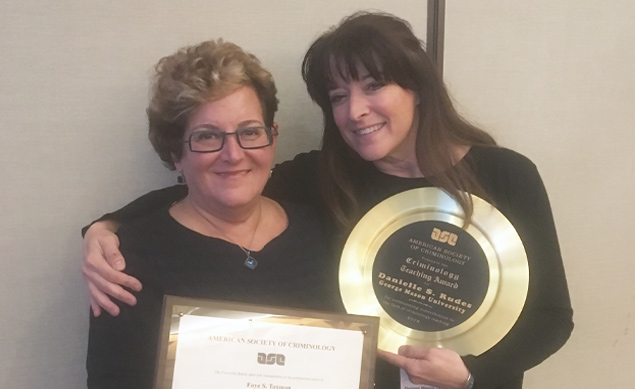
Photo of Dr. Faye Taxman

Dr. Faye Taxman


ACE! Director Dr. Faye Taxman is a methodologist specializing in randomized trials and interventions for individuals involved in the criminal justice system. She is recognized for her work in the development of the seamless systems of care models that link the criminal justice with other service delivery systems. Faye is a leader in translational research and has developed numerous tools that advance the field.
 

Photo of Dr. Danielle Rudes

Dr. Danielle Rudes


ACE! Deputy Director Dr. Daniell Rudes' research falls at the nexus of organizational theory and socio-legal studies where she is broadly interested in understanding how street-level workers negotiate organizational change and the impact their decisions have upon policy and practice. Danielle is involved in qualitative fieldwork and data collection examining various aspects of organizational change among police in Trinidad, among Federal Drug Court work-groups, and with correctional officers in Maryland.


George Mason University logo

George Mason University
Criminology, Law and Society

Home | About | Research | Criminology, Law, & Society | Partners | Tools | Products & Publications